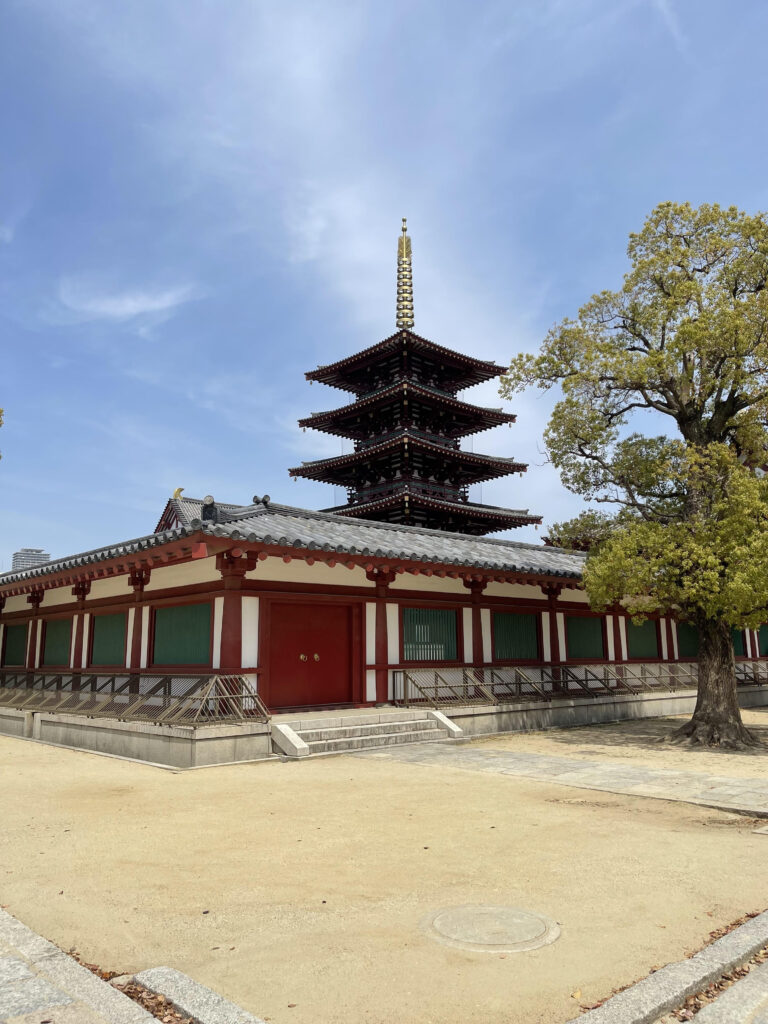
Shitennoji Temple, located in Tennoji Ward, Osaka City, is a temple that holds an extremely important position in the history of Japanese Buddhism.
According to tradition, it is said to have been founded in the Asuka period, in the first year of Empress Suiko’s reign (593 AD), and is considered the oldest officially established temple in Japan.
Throughout its long history, Shitennoji Temple has been repeatedly struck by fires and wars, but has been rebuilt each time and remains a renowned temple that attracts the faith of people today.
At the center of the temple grounds, a unique layout of temple buildings can be seen (the main gate, five-story pagoda, main hall, and lecture hall are arranged in a straight line), preserving the architectural style of temples from that era.
Within the temple grounds, historical buildings such as the “Gokuraku-mon” (Gate of Paradise) and the “Ishibutai” (Stone Stage), which are modeled after the Pure Land of Paradise, are scattered, making it a valuable site not only religiously but also culturally.
🔹 Gate of Paradise
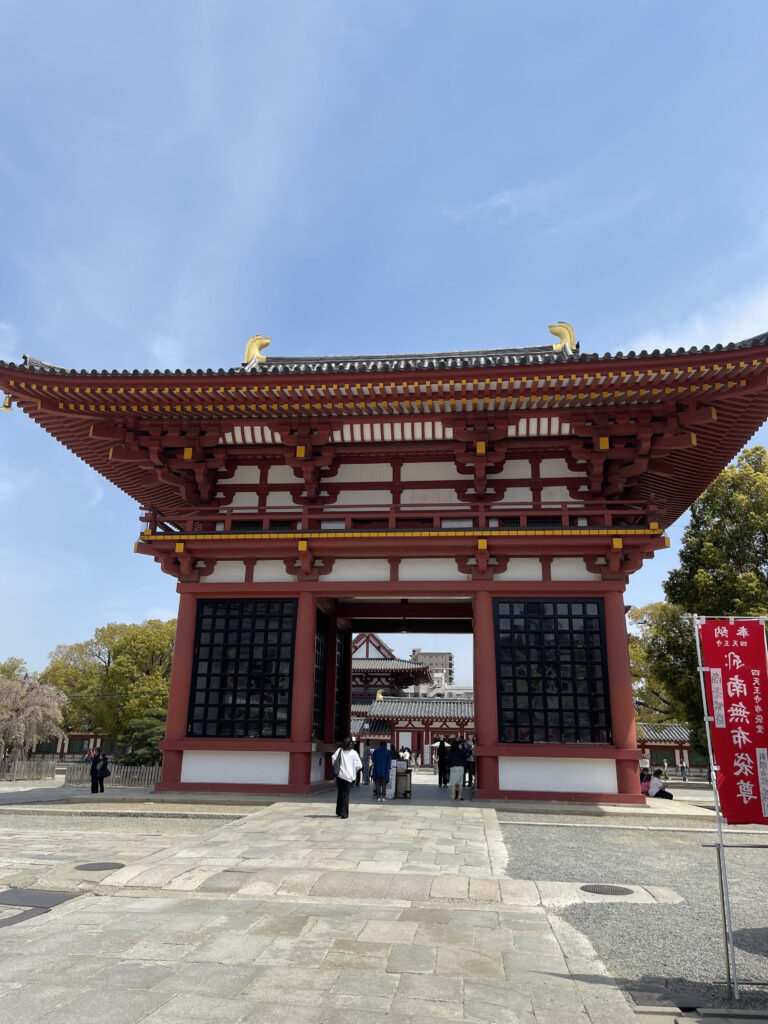
1-1. Basic Information about Shitennoji Temple
・Official Name: Shitennoji Temple, Head Temple of the Wa Sect
・Location: 1-11-18 Shitennoji, Tennoji-ku, Osaka City, Osaka Prefecture
・Sect: Wa Sect (Independent sect, with Shitennoji Temple as its head temple)
・Year of Founding: 593 AD (First year of Emperor Suiko’s reign)
・Founder: Shotokutaishi
・Principal Image: Guze Kannon (Goddess of Mercy)
Shitennoji Temple is not merely a Buddhist temple according to historical records; it is also considered to be Japan’s first temple to undertake social welfare projects, combining functions of medical care, relief, education, and lodging.
Thus, Shitennoji Temple served not only as a religious institution but also as an institution fulfilling social roles.
1-2. The Relationship Between Shotokutaishi and Shitennoji Temple
Shitennoji Temple is said to have been founded by Shotokutaishi (574-622 AD), a great figure of the Asuka period.
Shotokutaishi built Shitennō-ji Temple to promote Buddhism and ensure national stability.
According to tradition, during a battle against the Mononobe clan (a force opposed to Buddhism), the prince vowed to build a temple to enshrine the Four Heavenly Kings if he achieved victory. After his victory, he fulfilled this vow by constructing Shitennō-ji Temple.
The “Four Heavenly Kings” refer to the four celestial deities (Jikokuten, Zōchōten, Kōmokuten, and Tamonten) who protect the world in Buddhism, and were enshrined to pray for national peace and the flourishing of Buddhism.
Shotokutaishi positioned Shitennō-ji Temple not merely as a center of faith, but as a symbol of a new nation-building centered on Buddhism.
1-3. What was the purpose of Shitennō-ji Temple’s founding? (The role of Japan’s oldest official temple)
The purpose of Shitennō-ji Temple’s founding was not merely driven by personal faith, but had national significance.
In short, Shitennoji Temple was built to position Buddhism as the guardian deity of the nation and to spread Buddhism as a spiritual pillar for governing the country.
As an “official temple” (a temple built by order of the state), Shitennoji became the official center for the spread of Buddhism in Japan and had a significant influence on the spread of Buddhist culture.
Furthermore, Shitennoji possessed public facilities such as the Keiden-in, Seyaku-in, Ryobyo-in, and Hiden-in, and was a pioneer in social welfare activities.
Thus, Shitennoji was a religious institution that also incorporated social welfare, medical, and educational functions, making it arguably Japan’s first comprehensive facility.