
Shitennoji Temple is truly a “living historical heritage,” having walked hand in hand with Japanese Buddhist culture for over 1400 years.
Its history is interwoven with stories of glory, hardship, and restoration.
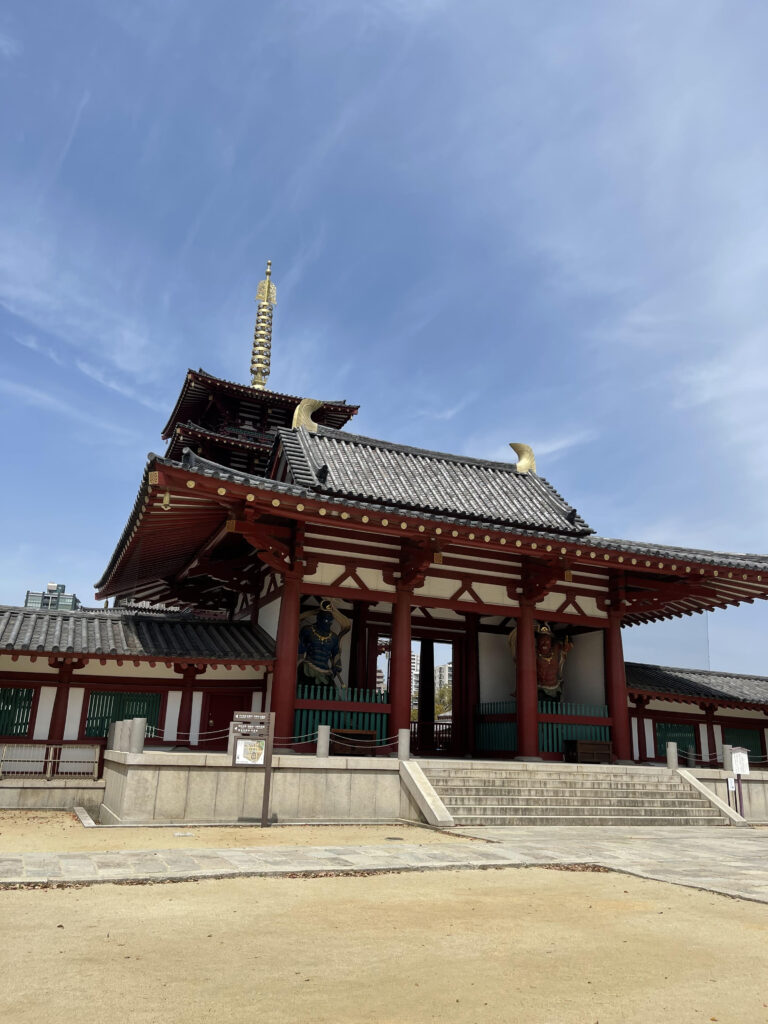
🔹 Chumon (Niomon Gate)
2-1. Main History from Founding to the Present
・1st Year of Empress Suiko’s Reign (593 AD)
Founded at the behest of Prince Shotoku. According to later theories, the initial temple complex was built using techniques introduced from Baekje, China, and represents one of the earliest Buddhist architectural styles in Japan.
・Nara and Heian Periods
Under state protection, many monks trained there, greatly contributing to the development of Japanese Buddhism. It was also deeply revered by emperors and nobles, and flourished as one of the centers of Buddhist culture.
・Medieval Period (Kamakura to Muromachi Periods)
Although affected by wars and political instability, restoration and reconstruction continued by rulers of each era. Even during this period, Shitennoji Temple was a popular center of popular faith.
・Early Modern Period (Edo Period)
Under the patronage of the Tokugawa family, improvements to the temple grounds and restoration of the buildings progressed. Furthermore, Shitennoji Temple became a very popular pilgrimage spot for ordinary people, and visiting Shitennoji became an integral part of Osaka culture.
・Modern Period (Meiji Era and Beyond)
While many Buddhist temples suffered a blow due to the separation of Shinto and Buddhism after the Meiji Restoration, Shitennoji also temporarily declined. However, it continued to be maintained through the efforts of believers and local residents.
2-2. War and Reconstruction | Post-War Reconstruction Episodes
・During World War II (1945 Osaka Air Raid)
Shitennoji suffered catastrophic damage in the Osaka air raid of March 1945, with major buildings such as the five-story pagoda and the main hall being destroyed by fire.
Although it was reduced to ruins for a time, the faith and strong will to rebuild remained undiminished.
・Post-War Reconstruction
Immediately after the war, a movement for reconstruction began, and donations were widely solicited.
With support from believers, local residents, businesses, and people from all over the country, the main temple buildings were rebuilt with reinforced concrete structures in the 1950s.
The five-story pagoda was rebuilt in 1959, restoring its original appearance.
・”Fusion of Tradition and Modern Technology”
In its reconstruction, while faithfully reproducing the exterior, the interior incorporated modern architectural techniques that considered earthquake resistance and fire resistance, representing a pioneering attempt in the restoration of historical Japanese architecture.
2-3. The Significance of Shitennoji Temple’s Continuity in Preserving Tradition
Shitennoji Temple is not simply an “old temple.”
Its great significance lies in its consistent preservation of its essential spirit of “salvation,” “peace,” and “compassion,” even as it has adapted to the changing times.
・Continuation of Religious Ceremonies
Even today, ancient ceremonies such as the “Taishi-e” (Prince Shotoku’s memorial service) and the “Ohigan Mantō Kuyō” (Lantern Offering Ceremony during the Autumn Equinox) are grandly held, ensuring the continuous transmission of tradition.
・Contribution to Local Culture
Shitennoji Temple has deep ties to the local community, frequently hosting flea markets (Shitennoji Antique Market) and community exchange events, making it an integral part of the lives of the people of Osaka.
・International Exchange
In recent years, many overseas Buddhists and tourists who resonate with Prince Shotoku’s philosophy of “harmony is to be valued” have visited the temple, and Shitennoji Temple plays an important role in disseminating Japanese culture and spirituality to the world.
In this way, Shitennoji Temple is a “living cultural asset” that continues to evolve with history, and can be said to be a symbol of Japanese spiritual culture.